Saturday, 7 May 2016
Evaluation Question 3 (glogster)
What kind of media institutions might produce my media product and why?

Friday, 6 May 2016
Evaluation Question 7 (Blogger)
What did I learn from the main task that I didn't learn from the preliminary task?
During the preliminary task I barely knew how to hold the camera steady for filming and didn't know how to edit, sound, images or effects, and didn't realise the effects that camera angles and continuity would have on my production. In short, my preliminary task was a crude and rushed example of what I could do with know prior knowledge or experience.
At the end of my main production, however, I knew how to use Photoshop and the majority of it's visual, sound and special effects, applying as many as I could without going over-saturating my production. To go into further detail:
There were many mistakes and production errors throughout the preliminary tasks and because I made the mistakes, I also learnt how to avoid such mistakes for my main production, For example I neglected the importance of camera angles and continuity during my preliminary task, this was not the case during my main task as careful attention was paid to how the camera angle would impact the audience's knowledge of what was happening.
As well as this, my storyboarding skills have also improved. During the preliminary task, my storyboard was little more than descriptive doodles, during my main production, however, my storyboard had detail on how the camera would act in each shot/scene and even went into some detail of what to add during editing, the majority of which was.
My planning also got better, the preliminary task's planning was done on the spot and filming the shots in chronological order. In the main production, however, the filming was done in order of location, rather than time, as to save time flitting between rooms and the locations were decided and written down beforehand as to not waste time looking.
The notes used as props in the production itself were used instead of printed messages and tape was used so I could make handwritten notes in an inconsistent, sinister font that also gave me a greater feel of creative licence.
Overall, I believe I have made vast improvements on the skills I used in the making of my preliminary task and have learnt new skills to a sufficient degree that I could apply them in future productions.
During the preliminary task I barely knew how to hold the camera steady for filming and didn't know how to edit, sound, images or effects, and didn't realise the effects that camera angles and continuity would have on my production. In short, my preliminary task was a crude and rushed example of what I could do with know prior knowledge or experience.
At the end of my main production, however, I knew how to use Photoshop and the majority of it's visual, sound and special effects, applying as many as I could without going over-saturating my production. To go into further detail:
There were many mistakes and production errors throughout the preliminary tasks and because I made the mistakes, I also learnt how to avoid such mistakes for my main production, For example I neglected the importance of camera angles and continuity during my preliminary task, this was not the case during my main task as careful attention was paid to how the camera angle would impact the audience's knowledge of what was happening.
As well as this, my storyboarding skills have also improved. During the preliminary task, my storyboard was little more than descriptive doodles, during my main production, however, my storyboard had detail on how the camera would act in each shot/scene and even went into some detail of what to add during editing, the majority of which was.
My planning also got better, the preliminary task's planning was done on the spot and filming the shots in chronological order. In the main production, however, the filming was done in order of location, rather than time, as to save time flitting between rooms and the locations were decided and written down beforehand as to not waste time looking.
The notes used as props in the production itself were used instead of printed messages and tape was used so I could make handwritten notes in an inconsistent, sinister font that also gave me a greater feel of creative licence.
Overall, I believe I have made vast improvements on the skills I used in the making of my preliminary task and have learnt new skills to a sufficient degree that I could apply them in future productions.
Thursday, 5 May 2016
Evaluation question 1
Evaluation Question 6
What have you learnt about technologies from the process of constructing this product?
Wednesday, 20 April 2016
Distribution
Distributors
A distributor is an individual or organisation who represents a film at festivals and markets across the world and will attempt to sell it to televisions, airlines, coach companies that have those small TYV's on them as well as many other companies that show short films. The biggest (short)film distributors in England are Futureshorts, Shorts International, Dazzle and Network Ireland TV. Distributors often source new films in order to represent their distribution catalogue at film festivals around the world. These include but are not limited to the Cannes, Rotterdam, Berlinale, AFM and Sundance festivals (features) and Clermont-Ferrand, Tampere, Encounters and Toronto Worldwide Short Film Festival (shorts). The vast majority of films that distributors acquire are completed films sourced at film festivals and related markets.
Distribution Deals
Negotiating deals with distributors requires them to have certain rights to a film, aspects of distribution affected by the rights distributors have to a film are many. Territory, which countries the film can be distributed to by the distributor. Terms, the amount of time the distributor will have the rights to distribute a film. Rights Granted, the agreement that should distinguish between the media rights granted to the distributor, which can include theatrical, video and DVD, television rights etc., and the media rights reserved to the producer. If exclusive rights are agreed to, as apposed to non-exclusive, it will stop others from allowing others to show your film within a specified media/territory/term. Producer's warranties and representation, when the producer is asked to provide assurances that there is no infringement of copyright. Gross receipts, all monies actually received by the distributor from the exploitation of the film before any deductions have been made. Net proceeds, the amount payable to the producer from the proceeds derived from the exploitation of the film after costs incurred by the distributor have been deducted. Costs can include distributor fees, commission and expenses. Expense caps, in order to prevent the distributor claiming unreasonable amounts, which would reduce the amount left for the producer to compensate. Distributor's obligations, The distributor should be under obligations to maintain accurate and true records of sales and expenditure and the producer should have the right to receive regular accounting statements on the film. Termination, which is, in my opinion, perhaps the most important, the circumstances in which you can terminate the relationship with the distributor. If the distribution agreement is for a long period of time and a better deal comes along during that period, the wording of such a clause will often determine as to whether the producer can end the existing agreement.
Sales Agents
More rarely, both short and feature films can benefit from the skills of a Sales Agent, who works on selling a smaller range of films on behalf of the film's rights holder / producer. Agents are responsible for setting up the deals, but do not necessarily deal with all the contracts paperwork, taking a percentage fee from any sales that arise from their work. They tend to take slightly lower fees than distributors as they do not have such large overheads and provide no guarantees of sales. However you may need to pay them a retainer until they achieve a sale. They can also be responsible for setting up deals with film distributors per territory.
Sales and Income
It is very rare that a profit is made when selling a short film. It is not a good idea, and probably never will be, for companies and conglomerates alike to overspend on their budgets, hoping that they will get it back afterwards from selling the film. Short film distributors tend to sell films in packages to make their profit margins sustainable, with a slant on high production values, romance/comedy/ drama genres and avoidance of overly ‘adult' themes. Countries outside of the UK, including the EU member states and the USA, can legally withhold up to 40% of the due license fee as withholding tax until the producer provides the licensee with a certificate of residency with a local tax office, where the producer's company is registered.
Self-Distribution
Self explanatory. Advantages: The producer retains full control and rights over a film, allowing them to choose where the film is shown. Money made from sales must not be shared with a distributor.
Disadvantages: It is often a full time job and will likely be time consuming with the risk that the production will still fail anyway. It can limit options for sales as distributors often have established relationships with buyers. Requires a wide understanding of copyrights laws, clearly making it difficult for one person to manage.
http://www.bbc.co.uk/filmnetwork/filmmaking/guide/distribution/distribution
A distributor is an individual or organisation who represents a film at festivals and markets across the world and will attempt to sell it to televisions, airlines, coach companies that have those small TYV's on them as well as many other companies that show short films. The biggest (short)film distributors in England are Futureshorts, Shorts International, Dazzle and Network Ireland TV. Distributors often source new films in order to represent their distribution catalogue at film festivals around the world. These include but are not limited to the Cannes, Rotterdam, Berlinale, AFM and Sundance festivals (features) and Clermont-Ferrand, Tampere, Encounters and Toronto Worldwide Short Film Festival (shorts). The vast majority of films that distributors acquire are completed films sourced at film festivals and related markets.
Distribution Deals
Negotiating deals with distributors requires them to have certain rights to a film, aspects of distribution affected by the rights distributors have to a film are many. Territory, which countries the film can be distributed to by the distributor. Terms, the amount of time the distributor will have the rights to distribute a film. Rights Granted, the agreement that should distinguish between the media rights granted to the distributor, which can include theatrical, video and DVD, television rights etc., and the media rights reserved to the producer. If exclusive rights are agreed to, as apposed to non-exclusive, it will stop others from allowing others to show your film within a specified media/territory/term. Producer's warranties and representation, when the producer is asked to provide assurances that there is no infringement of copyright. Gross receipts, all monies actually received by the distributor from the exploitation of the film before any deductions have been made. Net proceeds, the amount payable to the producer from the proceeds derived from the exploitation of the film after costs incurred by the distributor have been deducted. Costs can include distributor fees, commission and expenses. Expense caps, in order to prevent the distributor claiming unreasonable amounts, which would reduce the amount left for the producer to compensate. Distributor's obligations, The distributor should be under obligations to maintain accurate and true records of sales and expenditure and the producer should have the right to receive regular accounting statements on the film. Termination, which is, in my opinion, perhaps the most important, the circumstances in which you can terminate the relationship with the distributor. If the distribution agreement is for a long period of time and a better deal comes along during that period, the wording of such a clause will often determine as to whether the producer can end the existing agreement.
Sales Agents
More rarely, both short and feature films can benefit from the skills of a Sales Agent, who works on selling a smaller range of films on behalf of the film's rights holder / producer. Agents are responsible for setting up the deals, but do not necessarily deal with all the contracts paperwork, taking a percentage fee from any sales that arise from their work. They tend to take slightly lower fees than distributors as they do not have such large overheads and provide no guarantees of sales. However you may need to pay them a retainer until they achieve a sale. They can also be responsible for setting up deals with film distributors per territory.
Sales and Income
It is very rare that a profit is made when selling a short film. It is not a good idea, and probably never will be, for companies and conglomerates alike to overspend on their budgets, hoping that they will get it back afterwards from selling the film. Short film distributors tend to sell films in packages to make their profit margins sustainable, with a slant on high production values, romance/comedy/ drama genres and avoidance of overly ‘adult' themes. Countries outside of the UK, including the EU member states and the USA, can legally withhold up to 40% of the due license fee as withholding tax until the producer provides the licensee with a certificate of residency with a local tax office, where the producer's company is registered.
Self-Distribution
Self explanatory. Advantages: The producer retains full control and rights over a film, allowing them to choose where the film is shown. Money made from sales must not be shared with a distributor.
Disadvantages: It is often a full time job and will likely be time consuming with the risk that the production will still fail anyway. It can limit options for sales as distributors often have established relationships with buyers. Requires a wide understanding of copyrights laws, clearly making it difficult for one person to manage.
http://www.bbc.co.uk/filmnetwork/filmmaking/guide/distribution/distribution
Thursday, 14 April 2016
Evaluation question 2 (Blogger)
How does your media product represent particular social groups?
My thriller does not really show a particular social group, class, gender or ethnicity, despite the actor being a white male, in a specific light, but represents students as a whole. The clothing within the film is representative of the typical, moody teenager with the weight of peer pressure heavy on their shoulders with minimal variation to the general style throughout the production. The location, sticking with the theme of students, is in a school in empty hallways, classrooms and social areas to also keep with the horror thriller theme with both props and actor strategically placed for POV shots and blind spots, which add a certain kind of suspense to the product. The character in the product represented students through realistic responses to finding weird notes everywhere you look telling you to commit crime i.e. transitioning from mildly creeped out to mad that someone is playing a joke on them.
I chose to represent students in the most realistic manner I could, so I attempted to make the actor look moody and reclusive, I did this by filming in empty halls and having them wear a hoody to make the character seem isolated and reclusive. This follows through to the stereotypes that I am using. At the beginning of the production, I portrayed the character as sceptical, apprehensive and unwilling to accept something they don't want to be there. In the middle, it transitions into disbelief and then onto anger as most "broody" teenagers would. The end lacks any further portrayal of the character as it includes a montage of previous shots and the title screen. I decided not to try and intentionally challenge any stereotypes as I wanted to make my film as generalizable to teenagers as possible, even if it means offending a few actual teenagers in the process.
Messages to the audience? Primarily, I am trying to convey the reality of peer pressure on society's members, it's youths in particular and I am doing this because teenagers are the most susceptible to peer pressure and the bandwagon and awareness of freewill and choice must be raised. Where peer pressure festers, drugs and alcohol more often than not, follow en mass.
My thriller does not really show a particular social group, class, gender or ethnicity, despite the actor being a white male, in a specific light, but represents students as a whole. The clothing within the film is representative of the typical, moody teenager with the weight of peer pressure heavy on their shoulders with minimal variation to the general style throughout the production. The location, sticking with the theme of students, is in a school in empty hallways, classrooms and social areas to also keep with the horror thriller theme with both props and actor strategically placed for POV shots and blind spots, which add a certain kind of suspense to the product. The character in the product represented students through realistic responses to finding weird notes everywhere you look telling you to commit crime i.e. transitioning from mildly creeped out to mad that someone is playing a joke on them.
I chose to represent students in the most realistic manner I could, so I attempted to make the actor look moody and reclusive, I did this by filming in empty halls and having them wear a hoody to make the character seem isolated and reclusive. This follows through to the stereotypes that I am using. At the beginning of the production, I portrayed the character as sceptical, apprehensive and unwilling to accept something they don't want to be there. In the middle, it transitions into disbelief and then onto anger as most "broody" teenagers would. The end lacks any further portrayal of the character as it includes a montage of previous shots and the title screen. I decided not to try and intentionally challenge any stereotypes as I wanted to make my film as generalizable to teenagers as possible, even if it means offending a few actual teenagers in the process.
Messages to the audience? Primarily, I am trying to convey the reality of peer pressure on society's members, it's youths in particular and I am doing this because teenagers are the most susceptible to peer pressure and the bandwagon and awareness of freewill and choice must be raised. Where peer pressure festers, drugs and alcohol more often than not, follow en mass.
Tuesday, 22 March 2016
Case Study: Spielberg
Steven Spielberg
Steven Spielberg was born on the 18th of December 1946 in Cincinnati in the state of Ohio of the USA and is one of Hollywood's most famous film directors as well as one of the wealthiest filmmakers in the world.
His first film, in which he was an uncredited assistant editor was the classic western Wagon Train (1957). His other works as an assistant editor were The Last Gun (1959), Battle Squad(1961) and Escape to Nowhere (1961) in which his sister, Anne Spielberg, also played a part.
His first film as a director was in 1964 when he directed Fireflight (1964) a movie about a small town being invaded by aliens. Then, in 1967 he directed Slipstream, however, this was never finished. in 1968, he directed Amblin' (1968), which featured the desert prominently, and not the first of his movies in which the desert would feature so prominently. Amblin' also became the name of his production company, which turned out such classics as E.T. the Extra-Terrestrial (1982). Spielberg had a unique and classic early directing project, Duel (1971), with Dennis Weaver. Most of his other work in the early 1970's, however, was on TV projects such as Rod Serling's Night Gallery. This did not, however, stop his first major directorial effort The Sugarland Express (1974) which marked him as a rising star.
Spielberg's next work was the piece that made him known the world over: Jaws (1975). This classic shark attack tale started the tradition of the summer blockbuster or, at least, he was credited with starting the tradition.
Jaws (1975):
| Distributed by | Universal Pictures |
|---|---|
Release dates
|
|
Running time
| 124 minutes |
| Country | United States |
| Language | English |
| Budget | $9 million |
Following Jaws was Spielberg's unique sci-fi film that remains a classic to this day, ' Close Encounters of the Third Kind'. Spielberg hit gold yet one more time with Raiders of the Lost Ark (1981), with Harrison Ford taking the part of Indiana Jones. Spielberg produced and directed two films in 1982. The first was Poltergeist (1982), but the highest-grossing movie of all time up to that point was the alien story E.T. the Extra-Terrestrial (1982). Spielberg also helped pioneer the practice of product placement. The concept, while not uncommon, was still relatively low-key when Spielberg raised the practice to almost an art form with his famous (or infamous) placement of Reece's Pieces in "E.T." Spielberg was also one of the pioneers of the big-grossing special-effects movies, like "E.T." and "Close Encounters", where a very strong emphasis on special effects was placed for the first time on such a huge scale. In 1984, Spielberg followed up "Raiders" with Indiana Jones and the Temple of Doom (1984), which was a commercial success but did not receive the critical acclaim of its predecessor. As a producer, Spielberg took on many projects in the 1980s, such as The Goonies (1985), and was the brains behind the little monsters in Gremlins (1984).
In the late 1980's, Spielberg became the centre of pop culture again due to the landmark animation/live-action film Who Framed Roger Rabbit (1988). This film was closely followed the next year by Indiana Jones and the Last Crusade (1989), and Back to the Future Part II (1989). All three of these films were critical successes in both the cinema and box-office.
Throughout the 90's Spielberg was a strong supporter of animation, something he had a great affinity for as evidenced in 'Who Framed Roger Rabbit'.
Spielberg was very active in the early 1990s, as he directed Hook (1991) and produced such films as the cute fantasy Joe Versus the Volcano (1990) and An American Tail: Fievel Goes West (1991). He also produced the unusual comedy thriller Arachnophobia (1990), Back to the Future Part III (1990) and Gremlins 2: The New Batch (1990). Whilst every one of these films was successful in their own right, none quite reached the kind of box-office or critical acclaim as some of his earlier work.
In 1993, Spielberg directed Jurassic Park (1993), which for a short time held the record as the highest grossing movie of all time, but did not have the universal appeal of his previous efforts. Big box-office spectacles were not his only concern, however. He produced and directed Schindler's List (1993), a stirring film about the Holocaust. He won best director at the Oscars, and also got Best Picture. In the mid-90s, he helped found the production company DreamWorks, which was responsible for many box-office successes. A second comeback, if you will, after who framed roger rabbit, which was in and of itself a comeback from Jaws.
As a producer, he was very active in the late 90s, responsible for such films as The Mask of Zorro (1998), Men in Black (1997) and Deep Impact (1998). However, it was on the directing front that Spielberg was in top form. He directed and produced the epic that was Amistad (1997), a film that was shorted at the Oscars and in release due to the fact that its release date was moved around so much in late 1997. The next year, however, produced what many believe was one of the best films of his career: Saving Private Ryan (1998), a film about World War Two that is spectacular in almost every respect. It was stiffed at the Oscars, losing best picture to Shakespeare in Love (1998) which was directed by John Madden.
Saving Private Ryan:
Distributed by DreamWorks Pictures and Paramount pictures.
Released on July 24, 1998.
Running Time 169 minutes
Country United states of 'Murica
Languages English, German and French
Budget $70 million
Box office $481.8 million
Then, Spielberg produced a series of films, including The Haunting (1999), Evolution (2001) and Shrek (2001). he also produced two sequels to Jurassic Park (1993), which were financially but not particularly critical successes. In 2001, he produced a mini-series about World War Two that definitely was a financial and critical success: Band of Brothers (2001), a tale of an infantry company from its parachuting into France during the invasion to the Battle of the Bulge. Also in that year, Spielberg was back in the director's chair for A.I. Artificial Intelligence (2001), a movie with a message and a huge budget. It did reasonably at the box office and garnered varied reviews from critics.
Spielberg has been extremely active in films there are many other things he has done as well. He produced the short-lived TV series SeaQuest 2032 (1993), an anthology series entitled Amazing Stories (1985), created the video-game series "Medal of Honor" set during World War Two, and was a starting producer of ER (1994). Spielberg, if you haven't noticed, has a great interest in World War Two. He and Tom Hanks collaborated on Shooting War (2000), a documentary about World War II combat photographers, and he produced a documentary about the Holocaust called Eyes of the Holocaust (2000).
With all of this to Spielberg's credit, there is no wonder that he is looked at as one of the greatest ever figures in entertainment and, subsequentially, Media.
Tuesday, 15 March 2016
Textual Analysis of another students work
Youtube
Tupton Hall Media
2015 AS Final productions
Max Biddlecombe, Max Bradbury, Andreas Lee and Brad Roberts
The production team's name appears for 2 seconds and is in a red, creepy in front of a dark, misty forest with trees with no leaves, This could be to give us an idea of the theme and genre of their thriller opening which is likely a horror thriller. The camera angle is also a wide shot which gives us an, obviously, wide view of what is in front of the camera, in this case it is a dank, perpetual forest of ominous mist and perennial shadow.

The producer's name appears for 2 seconds in letters that appear cracked, like glass, giving the font a sinister, jagged edge. The blue sky and the dark forest also contrast, when combined with the aesthetically sinister, jagged font, the gloomy mirk emanating from the forest embeds the viewer with a primal fear, the sinister music does not help to alleviate this fear.


Tupton Hall Media
2015 AS Final productions
Max Biddlecombe, Max Bradbury, Andreas Lee and Brad Roberts
The production team's name appears for 2 seconds and is in a red, creepy in front of a dark, misty forest with trees with no leaves, This could be to give us an idea of the theme and genre of their thriller opening which is likely a horror thriller. The camera angle is also a wide shot which gives us an, obviously, wide view of what is in front of the camera, in this case it is a dank, perpetual forest of ominous mist and perennial shadow.

The producer's name appears for 2 seconds in letters that appear cracked, like glass, giving the font a sinister, jagged edge. The blue sky and the dark forest also contrast, when combined with the aesthetically sinister, jagged font, the gloomy mirk emanating from the forest embeds the viewer with a primal fear, the sinister music does not help to alleviate this fear.
The director's name appears for 2 seconds in the same cracked glass look, giving it the same jagged, almost eldritch, look. The positioning of the camera also makes the branches look like a natural cage with the killer staring at the camera, simultaneously filling the viewer with an ominous sense of dread and breaking the fourth wall.

The title appears for 6 seconds, yet again, in the same sinister, smashed glass font, but this time in front of a black background as if surrounded by a pure form of perpetual darkness, the kind we saw emanating from the perennial shadows of the forest in the first shot I explored.

In conclusion, the opening to the other students' work is like an ouroboros of shadow and darkness, setting the perfect scene for a horror thriller.
Friday, 4 March 2016
BBFC film regulation
British Board of Film Classification
U stands for universal and is an appropriate film for viewing by all ages, those younger than 4 inparticular, in accordance with the law. However, it is impossible to predict what might upset a particular child, especially at this lower end of the category range. This category allows only for infrequent, covert implications of what would be seen in films of a higher category.
strong violence
frequent strong language (e.g. 'f***').
portrayals of sexual activity
strong verbal references to sex
sexual nudity
brief scenes of sexual violence or verbal references to sexual violence
discriminatory language or behaviour
drug taking
(This list was taken from the BBFC website)There is no cap on the quantity or quality of strong language used in a 15 film. Racist, homophobic or other discriminatory language or behaviour. However, the film is under no circumstances, in accordance with the law, allowed to endorse said discriminatory language or behaviour. Venereal activity can be shown but must not go into detail whilst educational and non-sexual nudity can be shown with impunity. Sexual references and activity must be treated the same regardless of sexuality. Violence may be shown with impunity. Drugs are also allowed to be shown but must not be shown to promote or encourage said behaviours and must not be drugs that are easily accessible to 15 year olds, such as aerosols or solvents. Venereal violence is the only no for 15 films.
U stands for universal and is an appropriate film for viewing by all ages, those younger than 4 inparticular, in accordance with the law. However, it is impossible to predict what might upset a particular child, especially at this lower end of the category range. This category allows only for infrequent, covert implications of what would be seen in films of a higher category.
PG stands for parental guidance, allowing the film to be viewed by the general populace in accordance with the law. Films in this category should not unsettle a child around 8 or older, however, it may be unsuitable for children around the age of 4 and below. This category allows parents to judge whether or not the film is suitable for their child to watch. Also, this category often aims to explore more challenging issues such as bullying, bereavement or racism and allows for mild bad language such as sh*t but must be infrequent and is heavily reliant upon the context in which it is said as well as taking a similar stance on violence. This category, much like the U category, does not allow anything other than the vaguest of venereal references.
12A is the category that allows children under 12 to watch the film provided there is an adult there to supervise/authorise said 12 year old to do so. 12 means that no child under 12 can see this film under any circumstances. The BBFC's guidelines state that strong language, such as f***, is dependent upon the context in which it is said whilst it must remain infrequent, it also helps if moderate strong language, see PG example, may be used without contextual red tape. Discriminatory language is only allowed to be used if it is openly and clearly condemned. Venereal topics must be brief and vague and is dependent upon the context, the safest context for it to be used in, in 12A and 12 films, is comedy. Nudity is heavily contextual in this category and is only allowed in 12A films if it is "brief and discreet" whilst sexual references are treated the same regardless of sexuality. In this category, relatively frequent violence is allowed but should not dwell on detail such as emphasis on injuries or blood, though occasional gory moments can be permitted if they can sufficiently justify the context (e.g. brief sight of a bloody injury in a medical drama). Despite the requirement that they may not go into detail with injuries and wounds, fight scenes may be conducted at length, though any weapons that are easily accessible must not be glamorised or the films risk being graded as a 15. Venereal violence is also a no.
15 means that the minimum age requirement for the film is, you guessed it, 15. In this category, no themes are prohibited so long as the themes treatment is appropriate for 15 year olds. Watching a 15 film means that you run the risk of seeing
18; adults only in accordance with the law. No theme is prohibited as 18 year olds are supposedly smart enough to think for themselves, as they're so much smarter then 17 year olds. It is almost certain that you will see at least several of the following (again from the BBFC):
very strong violence
frequent strong language (e.g. 'f***') and / or very strong language (e.g. ‘c***’)
strong portrayals of sexual activity
scenes of sexual violence
strong horror
strong blood and gore
real sex (in some circumstances)
discriminatory language and behaviour
No limitations on language used. Discriminatory language can be used with impunity but must not under any circumstances breach the law.
There may be strong and detailed portrayals of sex at 18, including full nudity. There are no constraints on nudity in a non-sexual or educational context. Very strong, crude and explicit sex references are permitted at 18. An 18 film or video might also contain depictions of real sex, as long as the film or video is not a sex work(basically, pornography with plot)which would require it to be rated as an R18 film. Violence and subsequent wounds and injuries may be shown with impunity, this includes venereal violence. Strong horror and gore are permitted. All forms of drugs can be shown within this category, however, this cannot be encouraged or promoted within the films as it must be in accordance with the law.
The only things outright banned from 18 films are as follows(from the BBFC website)
- where the material is in breach of the criminal law, or has been created through the commission of a criminal offence.
- where material or treatment appears to us to risks harm to individuals or, through their behaviour, to society – for example, any detailed portrayal of violent or dangerous acts, or of illegal drug use, which may cause harm to public health or morals. This may include portrayals of sexual violence which might, for example, make rape look appealing, reinforce the suggestion that victims enjoy sexual violence or which invite viewer complicity in sexual violence.
- where there are more explicit images of sexual activity which cannot be justified by context. Such images may be appropriate in R18 works and, in ‘sex works’, would normally be confined to that category.
The R18 category is a special and legally-restricted classification primarily for explicit works of consenting sex or strong fetish material involving adults. Films may only be shown to adults in specially licensed cinemas, and video works may be supplied to adults only in licensed sex shops.
Monday, 22 February 2016
Storyboarding (Psychological thriller)
Psychological thriller opening
The storyboard below is for my psychological thriller and briefly explains which directions I am trying to aim my thriller in.


The storyboard below is for my psychological thriller and briefly explains which directions I am trying to aim my thriller in.


Friday, 29 January 2016
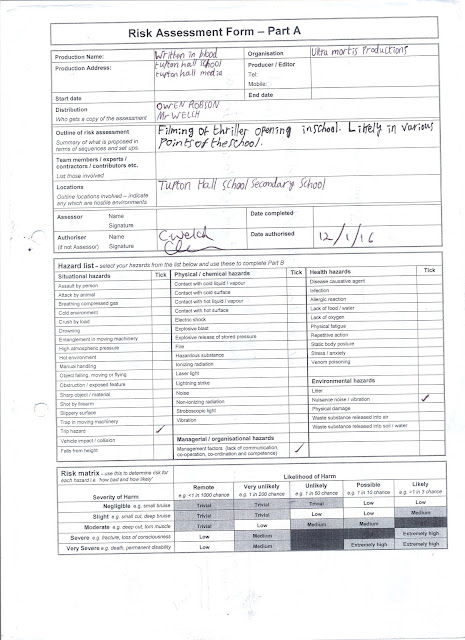
Psychological thriller risk assesment
This is the risk assessment form for my psychological thriller with all plausible risks listed thereupon.


Screenplay (Thriller)
The screen play for my psychological thriller are within the link below.
https://drive.google.com/file/d/0B19mbcK2n_ThRDM3RnNSMHAxVWM/view?usp=sharing
Tuesday, 15 December 2015
Lighting Task
3 point fill lighting
The 'Three Point Lighting Technique' is a standard method used in visual media such as video, film, still photography and computer-generated imagery. It is a simple but versatile system which forms the basis of most lighting.
If you only have one light, it becomes the key.If you have 2 lights, one is the key and the other is either the fill or the backlight. When you have three you can use 3 point fill lighting to its best effect.
The key light is the main light. It is usually the strongest and has the most influence on the look of the scene. It is placed to one side of the camera/subject so that this side is well lit and the other side has some shadow.
The fill light is the secondary light and is placed on the opposite side of the key light. It is used to fill the shadows created by the key. The fill will usually be softer and less bright than the key. To achieve this, you could move the light further away or use some spun.
The back light is placed behind the subject and lights it from the rear. Rather than providing direct lighting, like the key and fill, its purpose is to provide definition and subtle highlights around the subject's outlines. This helps separate the subject from the background and provide a three-dimensional look.
Chiaroscuro lighting
It is characterised by harsh lighting that creates an extreme contrast, often via dark and light colours, between different areas of the shot, such as the characters face, It can be used to good effect in both coloured and black and white lighting and is most often found in horror films E.G Nosferatu (1922)
High key lighting
Harsh, bright lights to reduce contrast (can be seen as the opposite of chiaroscuro lighting) in a scene, giving the scene a white washed, clean look that does not have any shadow inframe.
( The following elaboration is courtesy of internet research) High-key lighting is a style of lighting for film, television, or photography that aims to reduce the lighting ratio present in the scene. This was originally done partly for technological reasons, since early film and television did not deal well with high contrast ratios, but now is used to suggest an upbeat mood.
Backlighting
Backlighting is the process of illumination from the rear with the subject between said light and the camera, creating a glowing effect on the subject and, therefore, occurs when a scene is lit from behind and is often used for silhouettes such as the outline of a hooded figure. Can be used in any genre but is most commonly used in romances, take that for what you will.
Natural light/ing
This lighting most likely comes from a natural source such as the sun or moon, stars etc. and is most often white or yellow. This form of lighting is the most crude form, despite this, the time of day must be taken into account as the sun and moon tend to have noticeably moved around after an hour or two and must therefore be worked around lest continuity be thrown out of the metaphorical window.
Artificial lighting
This form of light is, quite obviously, the opposite of non-natural light. Oftentimes the light often has a blue-grey hue or a harsh yellow-orange hue. This form of lighting is more complex but with reduced risk of continuity failure in comparison to natural lighting and allows for longer use as its light source does not float around constantly and consistently in the sky as is the case with the aforementioned natural lighting.
The 'Three Point Lighting Technique' is a standard method used in visual media such as video, film, still photography and computer-generated imagery. It is a simple but versatile system which forms the basis of most lighting.
If you only have one light, it becomes the key.If you have 2 lights, one is the key and the other is either the fill or the backlight. When you have three you can use 3 point fill lighting to its best effect.
The key light is the main light. It is usually the strongest and has the most influence on the look of the scene. It is placed to one side of the camera/subject so that this side is well lit and the other side has some shadow.
The fill light is the secondary light and is placed on the opposite side of the key light. It is used to fill the shadows created by the key. The fill will usually be softer and less bright than the key. To achieve this, you could move the light further away or use some spun.
The back light is placed behind the subject and lights it from the rear. Rather than providing direct lighting, like the key and fill, its purpose is to provide definition and subtle highlights around the subject's outlines. This helps separate the subject from the background and provide a three-dimensional look.
Chiaroscuro lighting
It is characterised by harsh lighting that creates an extreme contrast, often via dark and light colours, between different areas of the shot, such as the characters face, It can be used to good effect in both coloured and black and white lighting and is most often found in horror films E.G Nosferatu (1922)
High key lighting
Harsh, bright lights to reduce contrast (can be seen as the opposite of chiaroscuro lighting) in a scene, giving the scene a white washed, clean look that does not have any shadow inframe.
( The following elaboration is courtesy of internet research) High-key lighting is a style of lighting for film, television, or photography that aims to reduce the lighting ratio present in the scene. This was originally done partly for technological reasons, since early film and television did not deal well with high contrast ratios, but now is used to suggest an upbeat mood.
Backlighting
Backlighting is the process of illumination from the rear with the subject between said light and the camera, creating a glowing effect on the subject and, therefore, occurs when a scene is lit from behind and is often used for silhouettes such as the outline of a hooded figure. Can be used in any genre but is most commonly used in romances, take that for what you will.
Natural light/ing
This lighting most likely comes from a natural source such as the sun or moon, stars etc. and is most often white or yellow. This form of lighting is the most crude form, despite this, the time of day must be taken into account as the sun and moon tend to have noticeably moved around after an hour or two and must therefore be worked around lest continuity be thrown out of the metaphorical window.
Artificial lighting
This form of light is, quite obviously, the opposite of non-natural light. Oftentimes the light often has a blue-grey hue or a harsh yellow-orange hue. This form of lighting is more complex but with reduced risk of continuity failure in comparison to natural lighting and allows for longer use as its light source does not float around constantly and consistently in the sky as is the case with the aforementioned natural lighting.
One Page Pitch
Written In Blood
I wanted to make a psychological thriller for the 12-15+ age range because I've always felt that films for these age ranges have always been too black and white, and I wanted to bring a certain degree of moral grey, the understanding of said moral grey and the understanding of the world we live in that comes with it. My target audience, 12-15, is such because 12 is the lowest grade psychological thrillers can achieve and 15 as this is the more common grade given to psychological thrillers and is the fall back plan should the content not be suitable for a 12.
A psychological thriller that follows a (insert gender) on their journey of discovering the weight that societal and sociological judgement has on them and society itself via imagined notes written in blood and imagined, inaudible whispers of those closest to them judging their every move.
A new take on the psychological thriller genre that follows a student on how they deal with the constant peer pressure constantly nagging at the back of their mind and how they react towards said constant nagging.
My main character will be the average student who has plenty of friends but none of them who is really close and can be likened to a sheep and is in denial of the effects of the voices of said friends weighing upon their psyche. The rest of the characters around them will be easily interchangeable and forgettable in order to keep the focus on the main character.
My source of actors will likely come from within the school, possibly some drama students, preferably A level but I will settle for GCSE drama students if no other choice presents itself. The school itself will likely be the location of the project, especially the areas of the school with dark corners where blood written post-its can be placed as well as some inaudible whispers introduced via the editing process.
I wanted to make a psychological thriller for the 12-15+ age range because I've always felt that films for these age ranges have always been too black and white, and I wanted to bring a certain degree of moral grey, the understanding of said moral grey and the understanding of the world we live in that comes with it. My target audience, 12-15, is such because 12 is the lowest grade psychological thrillers can achieve and 15 as this is the more common grade given to psychological thrillers and is the fall back plan should the content not be suitable for a 12.
A psychological thriller that follows a (insert gender) on their journey of discovering the weight that societal and sociological judgement has on them and society itself via imagined notes written in blood and imagined, inaudible whispers of those closest to them judging their every move.
A new take on the psychological thriller genre that follows a student on how they deal with the constant peer pressure constantly nagging at the back of their mind and how they react towards said constant nagging.
My main character will be the average student who has plenty of friends but none of them who is really close and can be likened to a sheep and is in denial of the effects of the voices of said friends weighing upon their psyche. The rest of the characters around them will be easily interchangeable and forgettable in order to keep the focus on the main character.
My source of actors will likely come from within the school, possibly some drama students, preferably A level but I will settle for GCSE drama students if no other choice presents itself. The school itself will likely be the location of the project, especially the areas of the school with dark corners where blood written post-its can be placed as well as some inaudible whispers introduced via the editing process.
Thursday, 10 December 2015
Thriller Opening- initial ideas
The initial ideas for my (psychological) thriller opening are within the link below.
https://drive.google.com/file/d/0B19mbcK2n_Thd2MxSWRfdW1CdDg/view?usp=sharing
https://drive.google.com/file/d/0B19mbcK2n_Thd2MxSWRfdW1CdDg/view?usp=sharing
Friday, 20 November 2015
se7en textual analysis
Art Of The Title
7even (1995)
The production company, New Line Cinema appeared for 5 seconds, this may be in order to promote previous and future productions they did and attract fans to their other works and vice versa.


David Filcher is a relatively well known electronic media director and producer (film director, film producer, television director, television producer, and music video director) and, therefore, generally helps fund and direct in the films he works on (Think Steven Speilberg but not famous in the slightest outside of America).


7even (1995)
The production company, New Line Cinema appeared for 5 seconds, this may be in order to promote previous and future productions they did and attract fans to their other works and vice versa.
The producer, Arnold Kopelson, appears for 2 seconds, this may be because he has produced many other films, such as outbreak and the fugitive, and will lend credibility to other films he has produced. In short, he makes his films popular and his films make him popular.

David Filcher is a relatively well known electronic media director and producer (film director, film producer, television director, television producer, and music video director) and, therefore, generally helps fund and direct in the films he works on (Think Steven Speilberg but not famous in the slightest outside of America).

Brad Pitt is a very well known actor and is seen in a significant number of major films such as fight club, troy and inglourious basterds to name a few and therefore has many fans who would watch se7en simply because he is in it and may also encourage people who watch se7en to see his other films.
Morgan Freeman is, like Brad Pitt, a very famous actor and has also been in a fair few major films such as 'the shawshank redemption' and 'the dark knight' and is also likely in it as much for the prestige and attention he will bring the film than his actual acting skills.
The title itself appears for 5 seconds so you know what to search up for future merchandise i.e the DVD, and is made to look like this in order to fit into the macabre, sinister theme of the film.
In conclusion, I think that this is an effective opening because it shows the major talents for an effective amount of time in a font that grabs the audiences attention establishing both the major talent and the general themes and concepts of the movie, in this case a sinister murder/mystery
Thursday, 19 November 2015
Conventions of the Thriller Film Genre
The thriller is a broad genre of literature, film, gaming and television that often includes overlapping sub-genres. Thrillers are often fast paced with frequent action and resourceful heroes and OP villains.
Various literary devices such as suspense, red herrings, cliff-hangers, cheap surprises and false endings. are used extensively.
(Red Herring: when the audience is convinced that the suspect is the perpetrator and it is later revealed that someone else is the killer/criminal etc. E.G saw, the killer was playing dead in a pool of his own blood and is acting through an intermediary who we think is the actual killer.
Cheap Surprises: An easily generated shock via a sudden movement or sound.
False Endings: the audience think it's over when it isn't.)
Thriller Types
Spy thrillers: a government agent vs. another government's agent or terrorist group/ every James Bond film ever made.

Political thrillers: Thrillers in which the hero must ensure the stability of their government. E.G Argo. They are often based on actual events.

Military thrillers: Uniformed + military + above stated literary devices along with explosions and gun fire etc. E.G Saving Private Ryan.

Conspiracy thrillers: corporation cover-ups such as inhumane criminal acts. E.G The insider involves a corrupt, large tobacco company.

Medical thriller: The hero fights against the use of unethical medical procedures eg a doctor stopping a corrupt medical practice. E.G coma

Forensic thriller: When the hero is, more often than not, a forensic scientist or a detective who solves an often horrific and long running crime spree. E.G Bones of the lost.

Psychological thriller: Mental and emotional thriller that often ends badly (as in, lucky if 1 in 5 survives the film.) for the protagonist/s. E.G Se7en and black swan.

Horror thriller: These thrillers often couple the emotional and mental terror with physical pain and gore. E.G saw and silence of the lambs.

Many thrillers often overlap with mystery stories, but are distinguished by the structure of their plots as thrillers often occur on a far grander scale such as jewel heists or killing terrorists.
Various literary devices such as suspense, red herrings, cliff-hangers, cheap surprises and false endings. are used extensively.
(Red Herring: when the audience is convinced that the suspect is the perpetrator and it is later revealed that someone else is the killer/criminal etc. E.G saw, the killer was playing dead in a pool of his own blood and is acting through an intermediary who we think is the actual killer.
Cheap Surprises: An easily generated shock via a sudden movement or sound.
False Endings: the audience think it's over when it isn't.)
Thriller Types
Spy thrillers: a government agent vs. another government's agent or terrorist group/ every James Bond film ever made.

Political thrillers: Thrillers in which the hero must ensure the stability of their government. E.G Argo. They are often based on actual events.

Military thrillers: Uniformed + military + above stated literary devices along with explosions and gun fire etc. E.G Saving Private Ryan.

Conspiracy thrillers: corporation cover-ups such as inhumane criminal acts. E.G The insider involves a corrupt, large tobacco company.
Medical thriller: The hero fights against the use of unethical medical procedures eg a doctor stopping a corrupt medical practice. E.G coma

Forensic thriller: When the hero is, more often than not, a forensic scientist or a detective who solves an often horrific and long running crime spree. E.G Bones of the lost.
Psychological thriller: Mental and emotional thriller that often ends badly (as in, lucky if 1 in 5 survives the film.) for the protagonist/s. E.G Se7en and black swan.

Horror thriller: These thrillers often couple the emotional and mental terror with physical pain and gore. E.G saw and silence of the lambs.

Many thrillers often overlap with mystery stories, but are distinguished by the structure of their plots as thrillers often occur on a far grander scale such as jewel heists or killing terrorists.
Friday, 6 November 2015
Art Of The Title Textual Analysis
Art Of The Title
Back to the Future (1985)
The director, Steven Spielberg's name appeared for 5 seconds, this may be because he is an extremely prestigious director and will attract fans of the director as well as fans of the films genre and will reassure the audience that the film will be of a good quality.


Back to the Future (1985)
The director, Steven Spielberg's name appeared for 5 seconds, this may be because he is an extremely prestigious director and will attract fans of the director as well as fans of the films genre and will reassure the audience that the film will be of a good quality.
The producer, Robert Zemeckis' name appeared for 4 seconds, this may be because he is a famous filmmaker and screenwriter who provided some of the funding for back to the future. The fact it says "A ROBERT ZEMECKIS Film" implies that his name appears for this long either because he is a famous filmmaker and screenwriter or because he provided a substantial amount of funding (the former in this particular case).


The title itself appears for 4 seconds, this is for the obvious reason of showing you what you are watching, however, it is presented in a way which emphasises the colours; drawing your eye towards it, the font makes the audience think of it as original and new.

Between this point and the next, we begin to hear dozens of clocks ticking in unison, reinforcing the theme of time travel present throughout the movie itself.
The lead actor's name, Michael J. Fox, appears for 5 seconds, this may be because he is a famous actor and producer and, like the director, may entice his fans, as well as fans of the genre, to watch the film. It is also at this point that the letters change in font to ensure that that the audience knows who are the actors and who are in charge.

In conclusion, I think that this is an effective opening because it shows the major talents for an effective amount of time in a font that grabs the audiences attention establishing both the major talent and the general themes and concepts of the movie (the clocks in the background).
Subscribe to:
Posts (Atom)